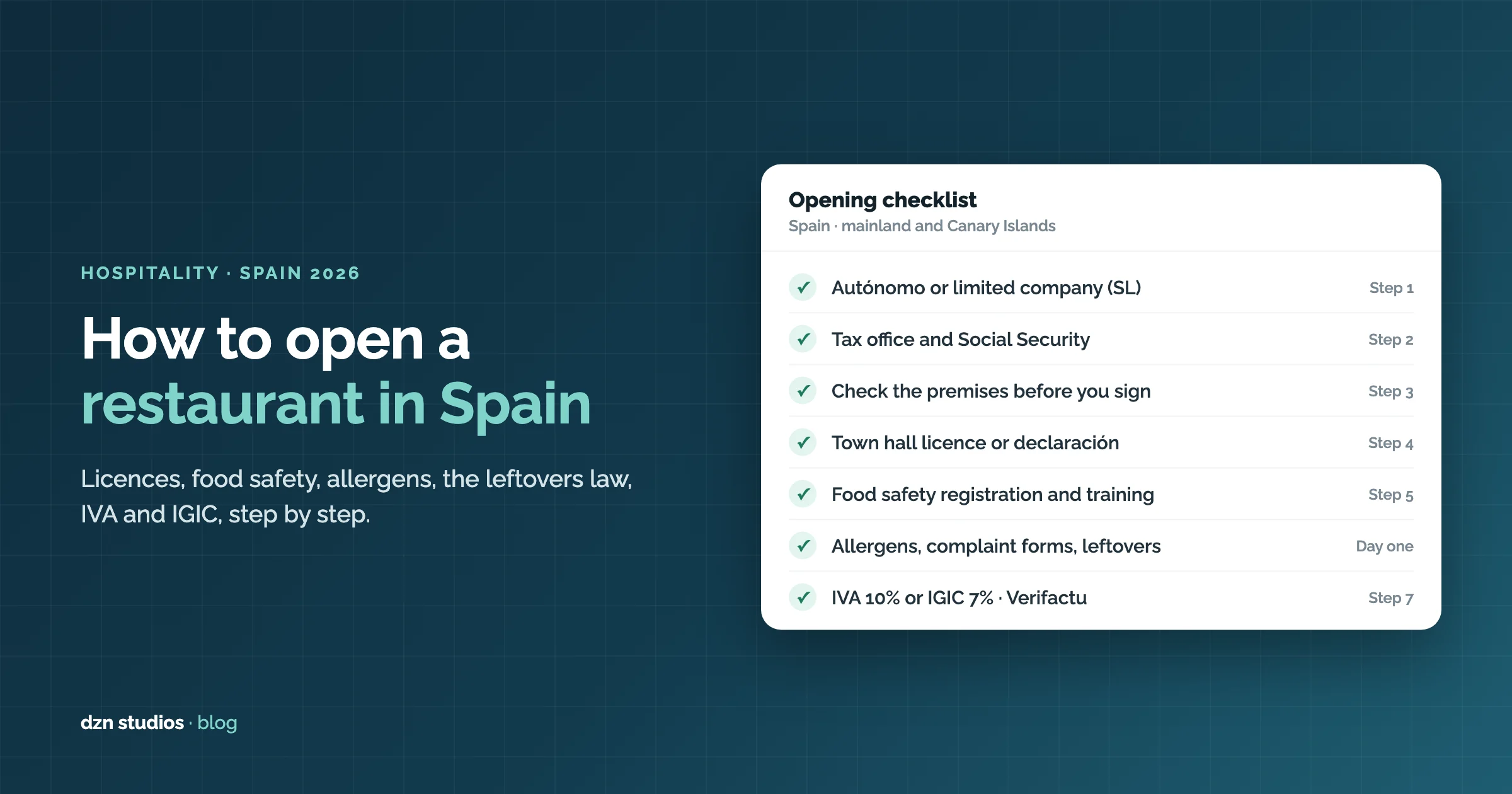
To open a restaurant in Spain: choose a business structure (self-employed autónomo or a limited company), register with the tax office and Social Security, check that your premises can legally be used as a restaurant, get your opening permission from the town hall (a declaración responsable or a full activity licence), register with your region’s food safety authority with a hygiene plan and trained staff, then sort out the day-one obligations: allergen information, complaint forms, prices including tax and free containers for leftovers. Allow from a few weeks to six months, mostly depending on the licence.
Before you start: this is a practical overview, not legal advice. Licences are set by each town hall and food safety rules by each autonomous community, so the exact forms and fees differ between, say, Madrid, Valencia and Tenerife. Use this guide to know what to ask, then confirm with your town hall and a local gestor or lawyer.
1. Choose your business structure
Most small restaurants start in one of two ways:
| Self-employed (autónomo) | Limited company (sociedad limitada, SL) | |
|---|---|---|
| Set-up | Quick and cheap | Needs a notary, company statutes and registration |
| Liability | Unlimited: your personal assets are at risk | Limited to the company’s assets |
| Good for | A small single restaurant, testing an idea | Partners, investors, bigger leases and loans |
If you aren’t Spanish you’ll also need an NIE (foreigner identity number), and if you’re from outside the EU, a residence and work authorisation that allows you to be self-employed or run a company.
2. Register with the tax office and Social Security
- Tax office (Agencia Tributaria): file the census declaration (modelo 036) to register the activity. Restaurants are usually registered under business activity tax (IAE) heading 671, “services in restaurants”. Cafés and bars have their own headings (672 and 673).
- Social Security: register yourself as self-employed, or register the company, and register every employee before their first shift.
A local gestoría will usually handle these in a day or two, and can keep your quarterly tax returns running afterwards.
3. Check the premises before you sign
The most expensive mistake is signing a lease for a unit that can’t be licensed as a restaurant. Before you sign:
- Ask the town hall (or an architect) whether the planning use allows a restaurant there. Many town halls offer a prior planning query (consulta urbanística).
- Check what the kitchen needs: smoke extraction to roof level is a common sticking point in blocks of flats.
- Check accessibility, fire safety, soundproofing (especially if you want music) and toilets.
- If a restaurant traded there before, ask for its licence. A transfer of an existing licence (cambio de titularidad) is often far quicker than a new one.
4. Get permission to open from the town hall
There are two main routes, and your town hall decides which applies:
- Declaración responsable (sworn declaration). You declare that the premises meet the rules, file the documents and can open, and the town hall inspects afterwards. Many smaller restaurants without major works use this route. The usual documents are the application, a technical report, plans and proof the fee is paid.
- Licencia de actividad (activity licence). Needed in many towns for larger premises, kitchens with smoke extraction, music or significant works. It requires a technical project signed by an architect or engineer, and you wait for approval before opening.
Separate permissions you may also need: a works licence if you’re refurbishing, a terrace licence for tables on the street, and, if you play music, licences from the music rights societies (such as SGAE). Public liability insurance is commonly required too.
5. Food safety registration, hygiene plan and training
- Register with your region’s health authority. Restaurants notify the autonomous community’s food safety department before starting, usually through a prior communication form. It can run in parallel with the licence.
- Have a food safety self-control plan. EU hygiene rules (Regulation (EC) 852/2004) require procedures based on HACCP (APPCC in Spanish): temperatures, cleaning, suppliers, traceability and pest control, with records you can show an inspector.
- Train everyone who handles food. Spain abolished the compulsory food handler card in 2010. What’s required now is training suited to each person’s job, which the business must be able to show. Most restaurants use an accredited course and keep the certificates.
6. The rules that apply from day one
- Allergen information. Under Royal Decree 126/2015 you must tell customers which of the 14 regulated allergens each dish contains, in writing (menu, allergen chart) or verbally, as long as the information is also kept in writing for customers and inspectors. “Everything may contain allergens” isn’t acceptable.
- Leftovers and food waste. Spain’s food waste law, Ley 1/2025, requires restaurants to let customers take home what they haven’t eaten, to say so visibly, and to give them a suitable container free of charge (buffets are the main exception), and to have a food waste prevention plan.
- Complaint forms. Every region requires official complaint forms (hojas de reclamaciones) available to customers, and a sign saying so. Get the forms from your region’s consumer office.
- Prices. Menu prices must include tax. Any extra charge, such as bread or a cover charge, must be shown on the menu, and customers can’t be charged for something they didn’t order.
- No smoking indoors, and check your region’s rules for terraces.
7. Tax and invoicing
| Where | Tax on restaurant bills |
|---|---|
| Mainland Spain and the Balearic Islands | IVA at the reduced rate of 10% |
| Canary Islands | IGIC at 7% (there is no IVA in the Canaries) |
Till and invoicing software (Verifactu). Spain is bringing in rules that billing software must record every invoice in a tamper-proof way and be able to send it to the tax office. Under Royal Decree-law 15/2025 the start dates are 1 January 2027 for companies paying corporation tax and 1 July 2027 for the self-employed and everyone else. There has been talk of a further delay, so check the current dates with the Agencia Tributaria, and when you buy a till system, ask the supplier whether it’s Verifactu-ready.
How long it takes and what it costs
These are rough ranges reported across Spain, to help you plan. Your town hall’s fees and your premises will decide the real figures.
| Step | Typical time | Typical cost |
|---|---|---|
| Register as autónomo or set up an SL | A few days to a few weeks | Low for autónomo; notary and registry fees for an SL |
| Declaración responsable | One to four weeks once documents are ready | Town hall fee plus a technical report; figures of about €500 to €2,500 are commonly reported for simple premises |
| Full activity licence with technical project | Two to six months, longer for complex premises | Higher: fees of up to about €3,000 are reported, plus the architect’s or engineer’s project and any works |
| Food safety registration | Two to eight weeks, in parallel | Usually small; the hygiene plan and training cost more |
Getting found before opening day
The paperwork gets you permission to open. It doesn’t get you customers. Start these a few weeks before you open:
- Claim your Google Business Profile with the right category, address, hours and photos, and add your opening date.
- Publish your menu on a website as text, not a PDF, with prices and allergens. It covers your allergen duty and it’s what Google and AI assistants can actually read.
- Make it easy to book from your website and your Google listing, without paying commission on every cover.
- Set up your listings on Tripadvisor, TheFork, Apple Maps and Bing Places with exactly the same details.
That last mile is what MesaAI, our restaurant product, does in an afternoon: it builds your website and QR menu from a photo of your menu, with allergens marked on every dish and menus in several languages, publishes it so Google and AI assistants such as ChatGPT can recommend you, and takes commission-free bookings. Read more in how to get your restaurant recommended by ChatGPT.
Frequently asked questions
What licence do I need to open a restaurant in Spain?
You need permission from your town hall (ayuntamiento) to run the activity in your premises. For many smaller restaurants without major works this is a declaración responsable, a sworn declaration that lets you open while the town hall checks it afterwards. Larger premises, kitchens with smoke extraction, music or major works usually need a full activity licence (licencia de actividad) with a technical project signed by an architect or engineer. Each town hall sets its own procedure, so check its activities ordinance first.
How long does it take to open a restaurant in Spain?
It depends mainly on the licence. A straightforward declaración responsable can be filed in days once your documents are ready, while a full activity licence with a technical project often takes two to six months, and longer for complex premises. Registering the business, the food safety registration and fitting out the premises can run alongside it.
Do I need a food handler certificate in Spain?
The old compulsory food handler card was abolished in 2010. The rule now is that anyone handling food must be trained in food hygiene in line with their work, and the business must be able to show that training. In practice most restaurants use an accredited course and keep the certificates on file.
Do restaurants in Spain have to show allergen information?
Yes. Under Royal Decree 126/2015 restaurants must tell customers which of the 14 regulated allergens are in each dish. It can be written (on the menu or a separate allergen chart) or given verbally, as long as the information is also kept in writing and available to customers and inspectors. Saying that everything may contain allergens is not acceptable.
Do I have to give customers a container for their leftovers?
Yes. Spain’s food waste law (Ley 1/2025) requires restaurants to let customers take home food they haven’t finished, to tell them so visibly, and to provide a suitable container free of charge. All-you-can-eat buffets are the main exception. Restaurants also need a food waste prevention plan.
What VAT do restaurants charge in Spain?
Restaurant and bar services are charged at the reduced IVA rate of 10% on the mainland and the Balearic Islands. In the Canary Islands there is no IVA: restaurants charge IGIC, at 7%. Prices shown to customers must include tax.
Can a foreigner open a restaurant in Spain?
Yes. You need a foreigner identity number (NIE), and non-EU citizens also need a residence and work authorisation that allows self-employment. The steps after that are the same as for a Spanish owner: register with the tax office and Social Security, get the licence, register for food safety and open.