
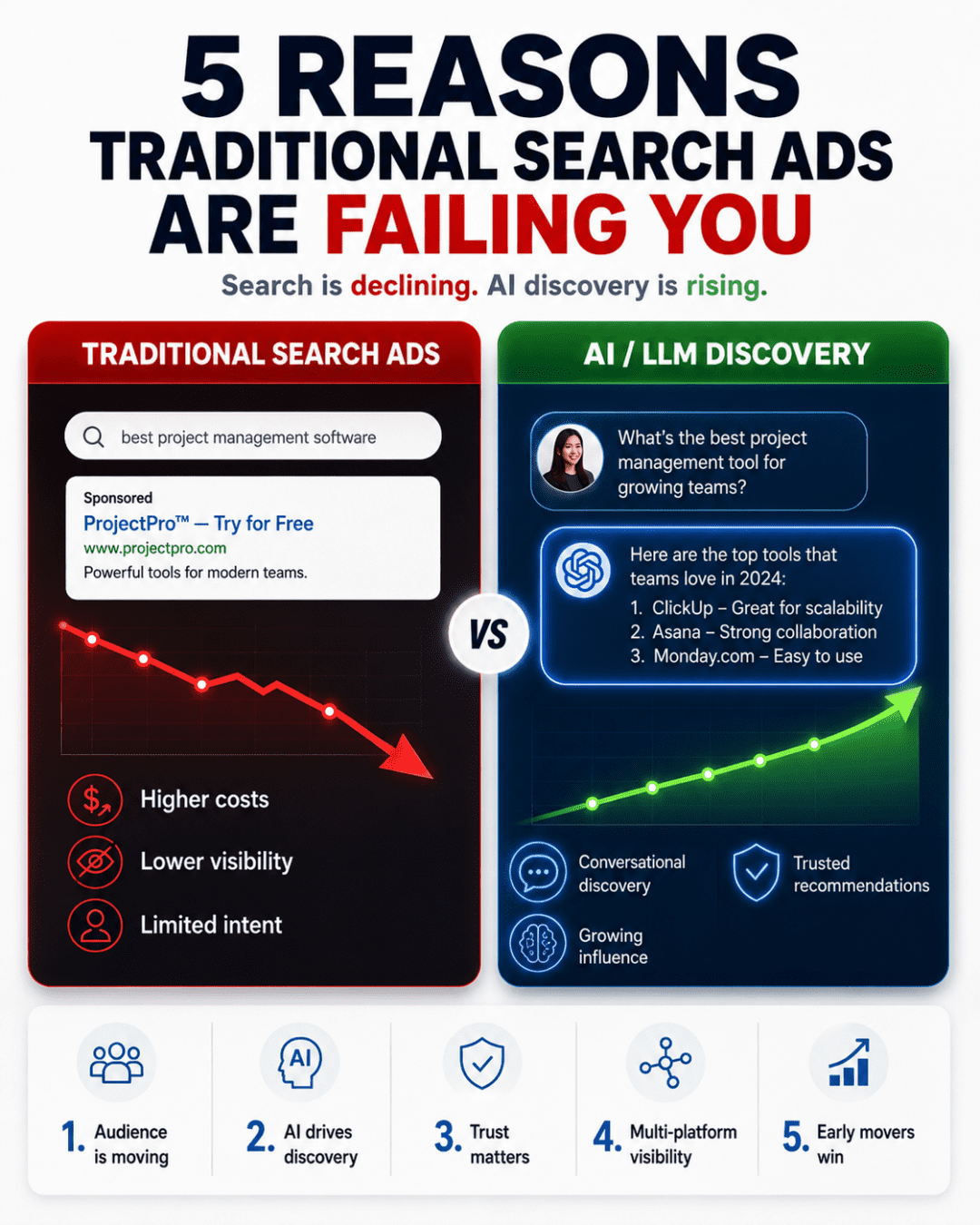
The era of “set it and forget it” Google AdWords is coming to a close. As AI tools like Gemini, ChatGPT, and Perplexity become the primary interface for information, the traditional search landscape is shifting from a directory of links to a direct-answer engine.
To survive this shift, we’ve developed a strategy that moves away from high-cost bidding on keywords and toward a Verification Loop for creative content. Here is how we are thinking about the future of digital spend.
The Strategy: The Organic-First Filter
The most expensive mistake a brand can make today is using paid media to “force” a bad creative to work. Instead of guessing which ad will resonate, we are now treating our organic social channels as a R&D laboratory.
- Low-Stakes Testing: Every piece of creative—whether it’s a 15-second video, an infographic, or a specific hook—is published organically first.
- The Statistical Outlier: We look for the “Alpha” content. If our average organic post reaches 1,000 people, but one specific video hits 8,000 without any help, that isn’t luck. It’s a market signal that the creative has high “shareability” and retention.
- Aggressive Scaling: We only move content into our paid ad manager once it has been verified by the audience for free. We aren’t paying for attention; we are paying to amplify attention we’ve already earned.
The logic: By the time a dollar of ad spend is touched, we already know the Click-Through Rate (CTR) potential is high.
The Rigorous Critique: Where This Logic Fails
While this “Organic-First” approach is our preferred model, we must be honest about its blind spots. If you follow this blindly, you will run into three major issues:
1. The Production Cost Paradox
“Organic is free” is a lie. High-volume content production requires significant labor, time, and gear. If you spend $5,000 in staff hours to produce enough content to find one “winner” that saves you $1,000 in ad waste, you haven’t optimized your business—you’ve just moved the expense from “Media” to “Operations.”
2. The Intent Gap
Social media is a discovery mechanism, but search (even AI-driven search) is an intent mechanism. A viral video about “How to fix a leaky pipe” creates brand awareness, but it doesn’t replace the effectiveness of a paid search result for “Plumber near me now.” We cannot assume that winning the “Attention” game automatically wins the “Conversion” game.
3. The Minimum Effective Audience
This strategy requires a baseline following to provide a valid sample size. If your organic reach is effectively zero, your “tests” are statistically irrelevant. You cannot verify a creative with a sample size of 15 views.
The Verdict: How to Move Forward
We believe the “Yellow Pages” era of search—where you simply bought your way to the top of a list—is being replaced by a Content Meritocracy.
Our Recommendation:
- Don’t abandon search entirely. Use it for high-intent, bottom-of-funnel conversions where people are ready to buy now.
- Adopt the Verification Loop for your brand awareness and top-of-funnel leads. Stop guessing what people like and let the data tell you.
- Small-Scale Paid Testing: If you lack an organic following, use “Micro-Budgets” ($5/day) to simulate organic testing. Run five different hooks for 48 hours. The one with the highest engagement becomes your primary ad.
The goal isn’t just to be “organic.” The goal is to stop subsidizing boring creative with your hard-earned marketing budget.


No Comments